01Core principles
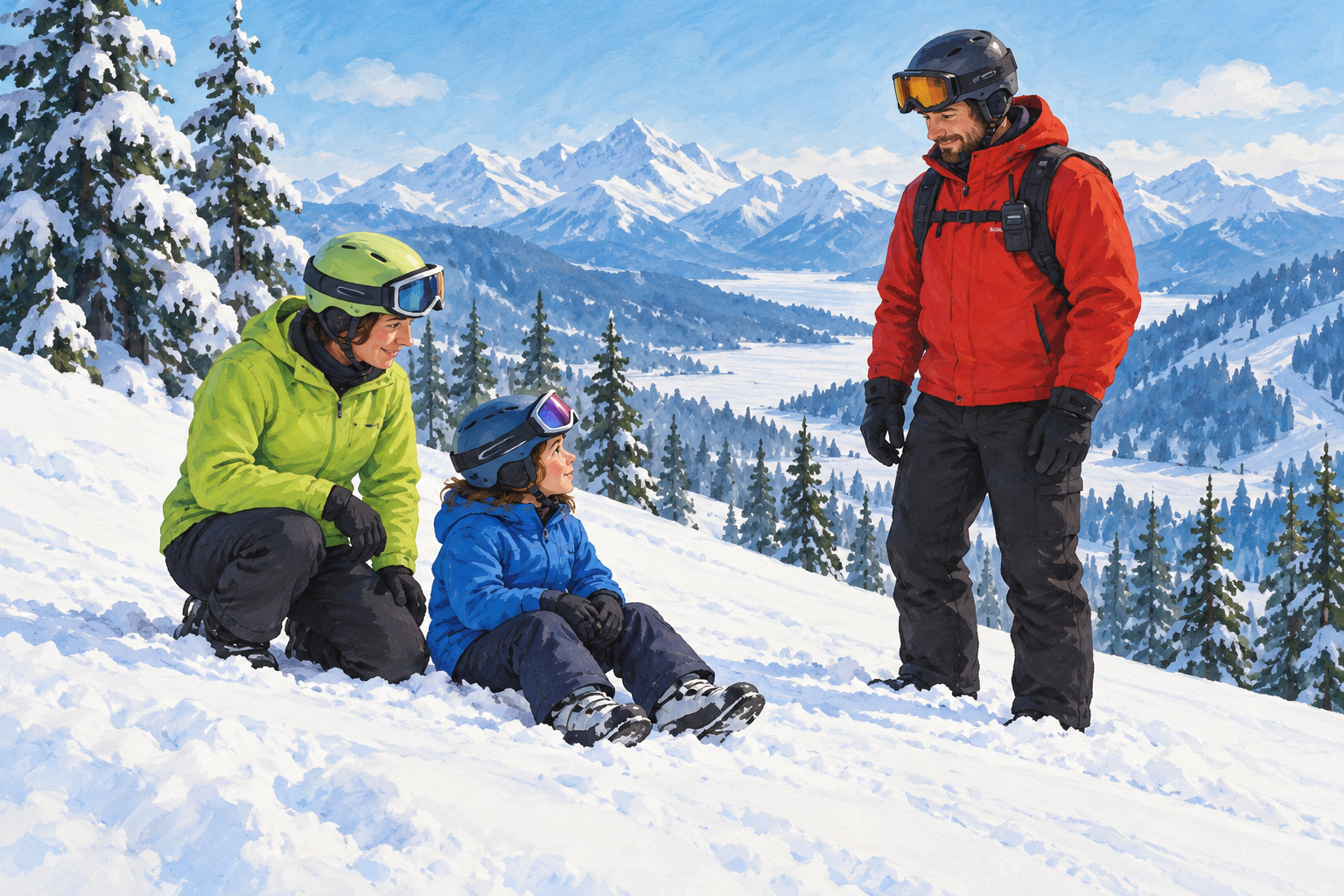
- Never leave the student alone unless Ski Patrol explicitly takes over their care.
- Never move someone with a suspected neck or spinal injury unless the scene poses a risk of further injury.
- Never make judgments about responsibility or fault at the scene, or admit fault to anyone.
- Never post images, video or information about the incident on social media.
02Secure the scene
Warn approaching traffic & prevent another collision
- Promptly mark the area uphill of the incident with crossed, upright skis or planted poles to warn approaching skiers and riders. If needed, position a companion farther uphill to give a warning.
- Gather the remaining students at a safe spot along the edge of the trail to prevent another incident.
Identify your location
Note the trail name and difficulty colour (green, blue or black), the nearest lift tower number or sign, and nearby landmarks such as a trail junction, ski shop or first-aid station.
03Call for help
Contact Ski Patrol first. In a life-threatening emergency, call 911 directly.
Call the resort’s emergency number or alert a nearby staff member, such as a lift operator.
| Resort | Phone / location |
|---|---|
| Blue Mountain Resort Dispatch | 705-445-0231 ext. 52900 |
| MSLM | 705-835-2112 1-877-835-2112 |
| Lakeridge | The ski patrol hut is on the north side of the chalet. |
| Horseshoe | 705-835-2790 |
| Dagmar | 905-649-2002 |
What to report
“Ski Patrol needed at [trail name / tower number]. [Brief description of injuries.] The person is [level of consciousness] and [breathing status]. The scene has been marked to warn approaching traffic.”
Continue caring for the student
- Keep the student warm—for example, cover them with a jacket to help prevent hypothermia.
- Keep reassuring them and watch for changes in consciousness or pain.
Stay with the student throughout. Do not chase the other person involved or leave the student.
04Notify TXSNOW
Once Ski Patrol is on the way or has taken over and the scene is stable, make the following notifications as soon as possible without interrupting care.
Contact TXSNOW staff
647-936-4161Information to include
- Time of the incident
- Resort, trail and lift tower number
- Session details: private 1:1 or group; skiing or snowboarding
- Student’s name and age group
- Injury overview: consciousness, breathing, main area injured and any suspected spinal or head injury
- Actions taken: scene warnings, keeping the student warm or controlling bleeding
- Whether Ski Patrol has been notified; arrival time and incident number, if available
- Arrangements for other students, if applicable
- Support needed at the scene
Notify the parent or guardian of a minor
TXSNOW staff will contact the parent or guardian. Instructors must relay facts only and avoid making medical judgments at the scene.
05Handover & evacuation
Once Ski Patrol arrives
- Brief Ski Patrol on the injured person’s condition, the actions already taken, and any known medical history, medication allergies or previous injuries—for example, information available in the PRE-SESSION INTAKE FORM.
- Record the patroller’s name or identification number and where the student is being taken, such as the first-aid room or off-site medical care.
What happens to the session
Private session
1:1
End the session or accompany the student while they receive care or are transported for medical treatment.
Dynamic Group Session
1:3
Prioritise the safety of the remaining students. The other instructor continues with three students, maintaining a safe and orderly group.
Group session
If the instructor must accompany the injured student, end the group session immediately.
06Document & submit the report
Record what happened
As soon as possible
Complete the TXSNOW Incident ReportCommunicating about the incident
State objective facts only. Do not make a medical diagnosis or comment on who was responsible.
07Follow-up & review
Check in with the student
Within 24–72 hours
TXSNOW staff will contact the student or their parent or guardian 24–72 hours after the incident to check on their wellbeing and explain the process.
TXSNOW incident review
Where necessary, pause teaching duties until the instructor has successfully completed refresher training.
- Review terrain selection, group positioning, speed control, the visibility of instructional cues, awareness of blind spots and equipment checks.
- If the SOP was not followed, provide retraining and document it.
Retain the records
Keep the report, radio and phone call times, photographs, Ski Patrol’s incident number and internal communications.
08Additional considerations
Media & bystanders
Politely decline requests to film or conduct interviews, and refer them to the person responsible for TXSNOW’s external communications.
Data & privacy
Use incident records only for safety and compliance purposes. Retain them in accordance with TXSNOW’s privacy policy, resort requirements and applicable law.
09Pocket reference
A quick guide for instructors
- CALL
Call for help
Contact Ski Patrol first.
- PROTECT
Protect the scene & the student
Warn traffic uphill, keep the student warm and immobilise them in place.
- STAY
Stay with the student
Do not leave the student until Ski Patrol takes over.
- REPORT
Notify the TXSNOW staff member on duty
Initial report within 2 hours; full report within 24 hours.
- DO NOT
Respect communication & privacy requirements
Do not admit fault, make a diagnosis or post on social media.